Where 2025-2026 Biotech Funding Went by Subsector
Therapeutic platforms and biologics took the largest share of 2025-2026 biotech funding activity, with AI biology, diagnostics, tools, omics, and enabling infrastructure shaping the next hiring wave.
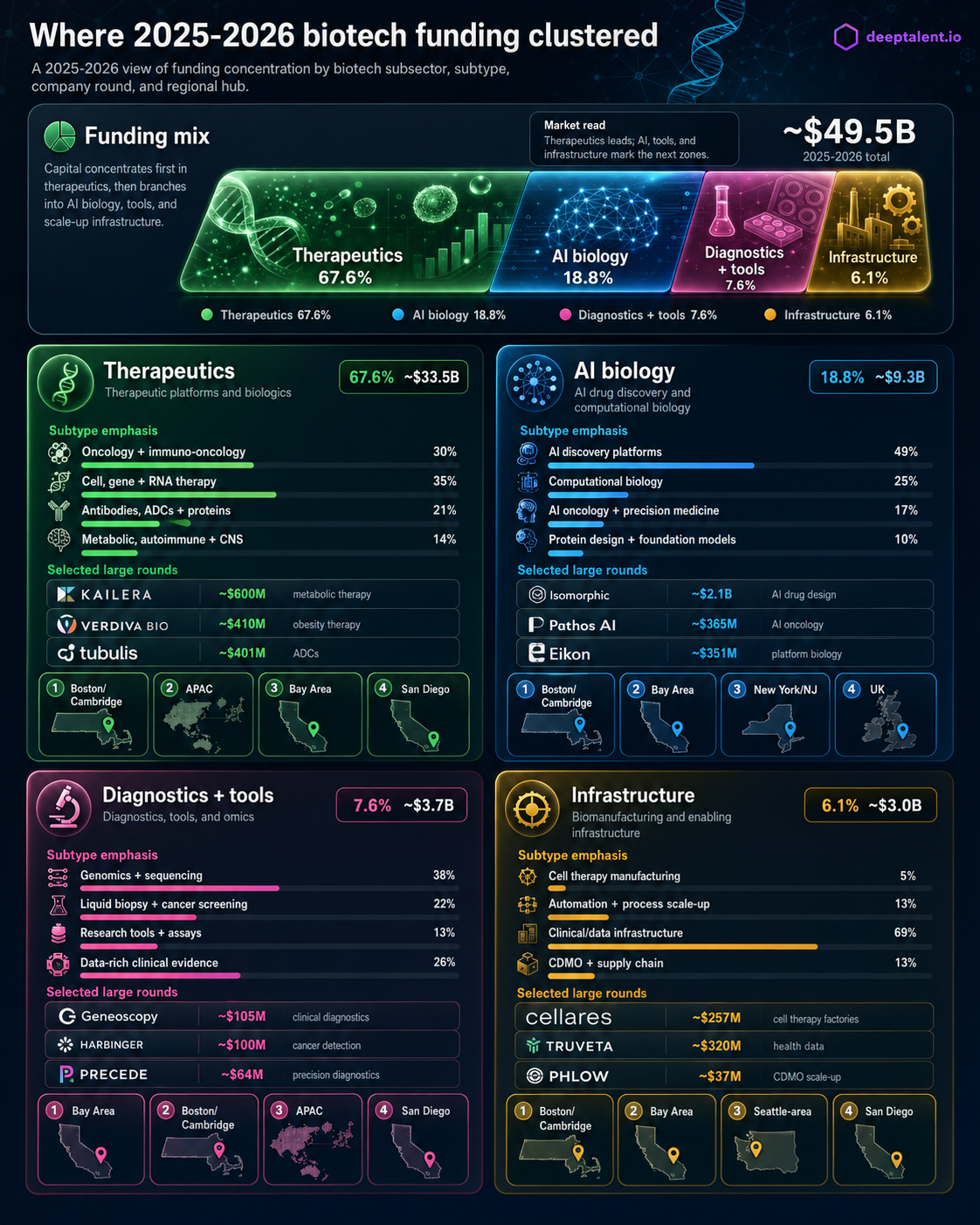
The approved DeepTalent.io funding map shows a clear capital concentration: therapeutic platforms and biologics carried roughly $33.5B, or 67.6% of the displayed 2025-2026 biotech funding total. AI drug discovery and computational biology followed at roughly $9.3B, or 18.8%. Diagnostics, tools, and omics accounted for roughly $3.7B, while biomanufacturing and enabling infrastructure accounted for roughly $3.0B.
Those funding bands matter because capital concentration usually becomes role concentration. Companies funded around therapeutic platforms, AI biology, diagnostics, tools, omics, manufacturing, and infrastructure need different mixes of scientists, engineers, clinical operators, CMC leaders, quality teams, computational biologists, and program leaders.
Therapeutic platforms and biologics took the largest share
The largest displayed funding band sits in therapeutic platforms and biologics. That includes companies building drug platforms, modality engines, biologics programs, and therapeutic pipelines that require discovery biology, translational work, clinical development, CMC, regulatory strategy, and business development.
For candidates, this means therapeutic platform experience remains one of the most transferable forms of biotech career capital. For employers, it means the strongest candidates may come from platform companies, biologics teams, antibody groups, translational medicine groups, and program-heavy therapeutic organizations.
AI biology moved into the second tier
AI drug discovery and computational biology formed the next major band in the displayed map. This includes companies using machine learning, computational biology, precision oncology, protein design, multimodal biology, and platform software to move discovery work faster or with better experimental targeting.
The hiring implication is concrete. These teams need machine-learning scientists, computational biologists, data engineers, research engineers, assay scientists, translational biologists, platform product teams, and leaders who can connect model work to wet-lab and drug-program decisions.
Diagnostics, tools, omics, and infrastructure still matter
Diagnostics, tools, and omics carried less dollar weight than therapeutics in the displayed map, but they influence what gets measured and trusted. These companies shape sequencing, biomarkers, assays, data generation, platform instrumentation, lab workflows, and the measurement base used by therapeutic teams.
Biomanufacturing and enabling infrastructure also matter because funded therapeutic ideas need to be made, scaled, tested, transferred, and controlled. CMC, process development, quality, supply chain, automation, and technical operations roles can become more important as funded programs move from idea to execution.
Funding maps should change search strategy
A hiring team should translate each funding band into the actual work it will create. Therapeutics funding may create discovery, translational, clinical, CMC, regulatory, and program leadership demand. AI biology funding may create ML, computational biology, data infrastructure, assay design, and platform engineering demand. Tools and diagnostics funding may create applications, assay, bioinformatics, product, and customer-facing technical roles.
Candidates should do the same translation in reverse. A funding trend becomes useful only when it points to the roles most likely to grow, the companies most likely to hire, and the skills that can move between subsectors.
How DeepTalent.io uses this work
DeepTalent.io connects funding context to company context, role scope, and candidate experience. A broad funding headline is too blunt for recruiting. A therapeutic-platform company, an AI-biology platform, a diagnostics company, and a biomanufacturing company may all be hiring, but they need very different shortlists.
The practical question is where the funded work turns into jobs: which teams need people now, which skills are becoming scarce, which companies have enough capital to build, and which candidates have already done the work.