Protein AI: Which Companies Are Actually Ahead?
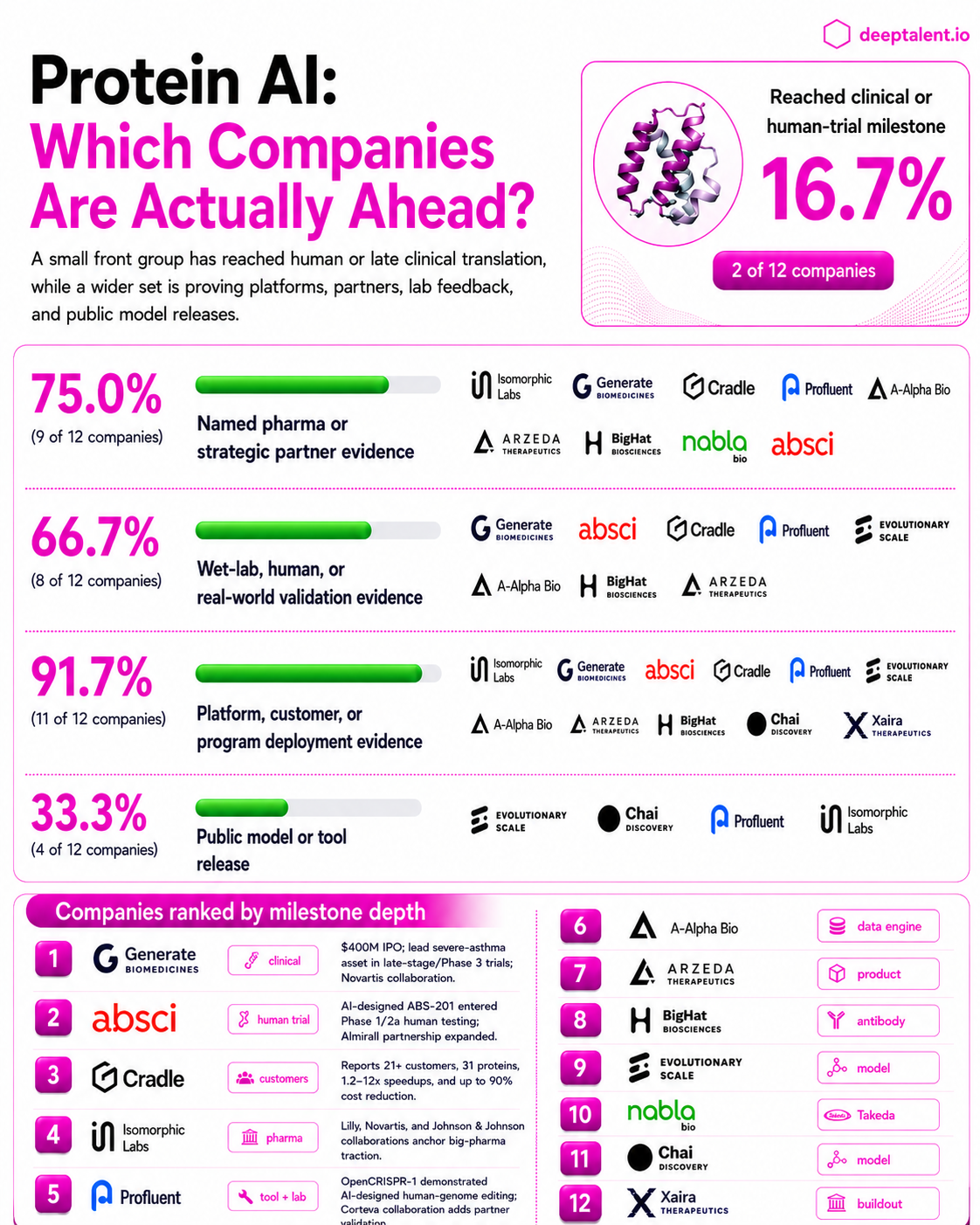
A small front group of protein AI companies has reached human or late clinical translation, while a wider set is proving platforms, partners, lab feedback, and public model releases.
Protein foundation models are moving from impressive demonstrations into design-build-test work. They help scientists propose structures, complexes, binders, variants, and sequences, but the useful work still depends on synthesis, expression, assays, characterization, and redesign.
The company field is separating by stage. Generate and Absci stand out for clinical or human-trial progress. Isomorphic Labs, Cradle, and Profluent stand out for pharma partnerships, platform traction, customer deployment, or public model/tool releases. That split matters for candidates and hiring teams because each stage needs a different mix of machine learning, protein engineering, antibody science, assay work, translational biology, platform engineering, and program execution.
The category contains several kinds of work
Protein language models, structure predictors, molecular-complex predictors, diffusion design tools, and inverse-folding tools solve related but different problems. Some tools propose structures. Some help design sequences for a desired structure. Some reason about molecular interactions. Some help prioritize variants before a team spends money in the lab.
That distinction matters because a role in protein foundation models can sit in model development, computational biology, antibody design, protein engineering, platform tooling, data engineering, assay interpretation, or translational decision-making. A broad AI label is too weak for hiring.
The design-build-test loop still decides value
The practical workflow starts with a target goal, generates candidate proteins or complexes, designs sequences, prepares synthesis and expression, measures binding, stability, specificity, developability, and function, then feeds the results into another design cycle.
That is why wet-lab validation remains central. A model can improve the starting point and reduce blind searching, but biotech teams still need assays, protein production, characterization, quality controls, and scientists who understand when a computationally attractive candidate is experimentally fragile.
Companies are separating by milestone type
Generate:Biomedicines and Absci have the clearest therapeutic-translation anchors in the approved DeepTalent.io research. Generate brings clinical-stage generative biology and pharma partnership scale. Absci brings an AI-designed antibody program in human testing plus a clear AI-to-wet-lab antibody engine.
Isomorphic Labs is strongest as a model-to-pharma partnership company. Cradle is strongest as a deployed protein-engineering software platform with customer programs. Profluent is strongest as a public model and AI-authored protein/gene-editor company. EvolutionaryScale and Chai Discovery shape the public-model conversation, while Xaira, A-Alpha Bio, BigHat, Arzeda, and Nabla Bio add important platform, data-engine, industrial, and therapeutic buildout context.
The cost appears after the model runs
Inference is only one cost. Teams also pay for compute, high-quality training and experimental data, licensing, data infrastructure, synthesis, expression, purification, assays, characterization, specialist staff, platform integration, and the time needed to close the loop between model output and lab results.
That is why the most useful cost question is operational: does the workflow produce better candidates, fewer failed rounds, faster assay learning, or a clearer route to a therapeutic or product decision? A model that cannot connect to the lab remains hard to translate into company value.
Hiring follows the workflow stage
Early model work needs ML scientists, research engineers, structural biologists, data engineers, and people comfortable with PyTorch, JAX, GPUs, sequence modeling, and molecular representation. Platform deployment needs software engineers, infrastructure engineers, scientific product teams, and computational biologists who can make the tools usable by scientists.
Therapeutic translation needs protein engineers, antibody scientists, assay scientists, translational biologists, CMC operators, program leaders, and clinical-development teams. Candidates should describe where they sit in the loop. Employers should define whether the role solves a modeling problem, a lab validation problem, a platform-deployment problem, or a program-execution problem.