The 2026-2031 Pharma Patent Cliff Will Hit Talent Plans
Keytruda, Eliquis, Opdivo, Darzalex, and Ibrance create a concentrated exclusivity window that will affect hiring, commercial planning, manufacturing, and lifecycle strategy.
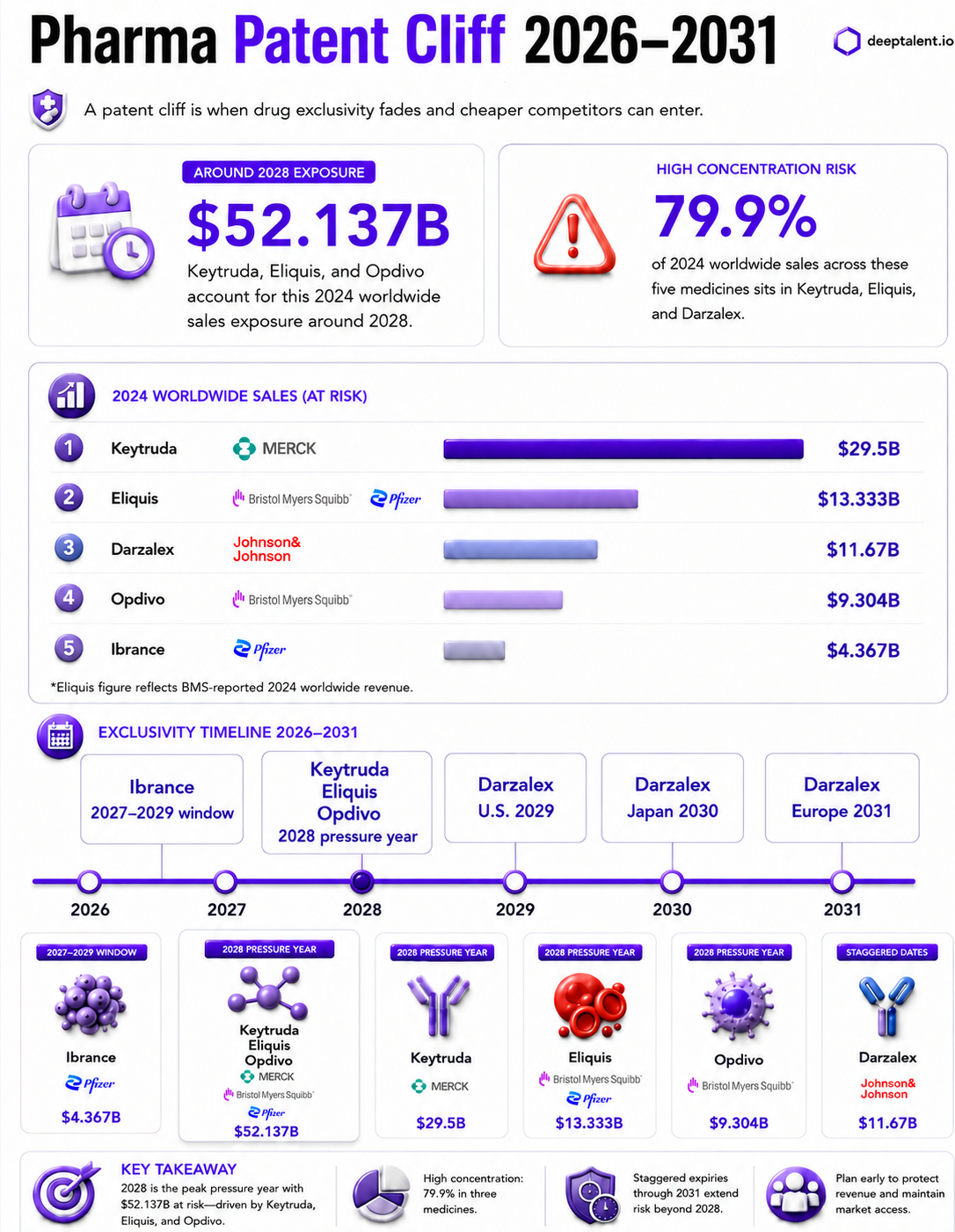
The 2026-2031 window concentrates major exclusivity pressure around a handful of blockbuster medicines. The largest pressure point lands around 2028, when Keytruda, Eliquis, and Opdivo move closer to meaningful generic or biosimilar exposure.
For hiring teams, patent-cliff planning turns into concrete workforce needs: lifecycle strategy, market access, biologics manufacturing, clinical development, pricing, payer strategy, regulatory execution, and commercial defense. For candidates, the same pressure can create better roles in companies that need people who can move products through a more competitive market.
2028 concentrates the pressure
The DeepTalent.io infographic centers the 2026-2031 risk window around five medicines: Keytruda, Eliquis, Opdivo, Darzalex, and Ibrance. Keytruda, Eliquis, and Opdivo create the sharpest common pressure year because each sits near a 2028 exclusivity inflection in major markets.
That timing matters because companies rarely respond to a patent cliff with one hiring move. They need commercial leaders who understand payer friction, manufacturing teams who can support lifecycle demand, regulatory people who can handle label and geography decisions, and technical teams who can build the next product cycle before revenue pressure shows up in quarterly results.
Darzalex spreads risk across markets
Darzalex creates a more staggered problem. The approved DeepTalent.io material places exposure across the United States in 2029, Japan in 2030, and Europe in 2031. That sequencing changes the operating work because market access, pricing, biosimilar readiness, and commercial defense can unfold differently by region.
A staggered cliff can give a company more planning room, but it also creates more execution points. Teams need to understand which country decisions matter first, which biosimilar entrants are ready, and where commercial teams need the most support.
Patent cliffs become hiring cliffs
A patent cliff is usually discussed as a revenue event. Inside companies, it becomes a talent event. Teams facing exclusivity pressure need people who can defend existing franchises, advance follow-on products, evaluate deal targets, manage technical operations, and translate late-stage clinical or commercial complexity into action.
That work reaches far beyond legal dates. It touches clinical operations, lifecycle management, biologics process development, quality, market access, commercial analytics, finance, business development, and medical affairs. The better hiring question is which teams need more capacity before the pressure year arrives.
What candidates can do
Candidates should read patent-cliff pressure as a clue about where companies may invest next. A lifecycle management role, a biosimilar defense role, a market-access role, or a next-generation product role can carry more strategic value when the company is protecting a large franchise.
Strong candidates can position themselves around concrete work: launch planning, payer strategy, formulation or delivery improvements, biologics manufacturing, regulatory sequencing, companion diagnostics, clinical operations, pricing, and portfolio planning.
What hiring teams can do
Hiring teams should separate broad pharma experience from the specific work needed near a patent cliff. The strongest shortlist for a lifecycle role may look very different from the strongest shortlist for biologics manufacturing, pricing strategy, medical affairs, or late-stage clinical development.
DeepTalent.io helps companies connect market pressure to the teams and candidates who can actually handle the work. The useful hiring question is where the revenue risk turns into specific operating needs.
The research centers on concentrated planning pressure
The deeper DeepTalent.io research started with a wider watchlist, then narrowed the public article toward the products with the clearest planning value. That is why the article centers Keytruda, Eliquis, Opdivo, Darzalex, and Ibrance instead of becoming a sprawling patent calendar.
The important planning point is concentration. Keytruda anchors the exposure by size, Eliquis adds small-molecule generic pressure, Opdivo adds a second immuno-oncology franchise near the same year, Darzalex extends the late-decade watchlist, and Ibrance creates an earlier oncology pressure window. A hiring team can use that map to separate commercial defense, biologics lifecycle work, small-molecule competition, and next-product planning.