Generate Biomedicines and Absci Are Building Different AI Protein Companies
Generate Biomedicines and Absci both use AI for protein therapeutics, but their hiring needs point toward different company-building work.
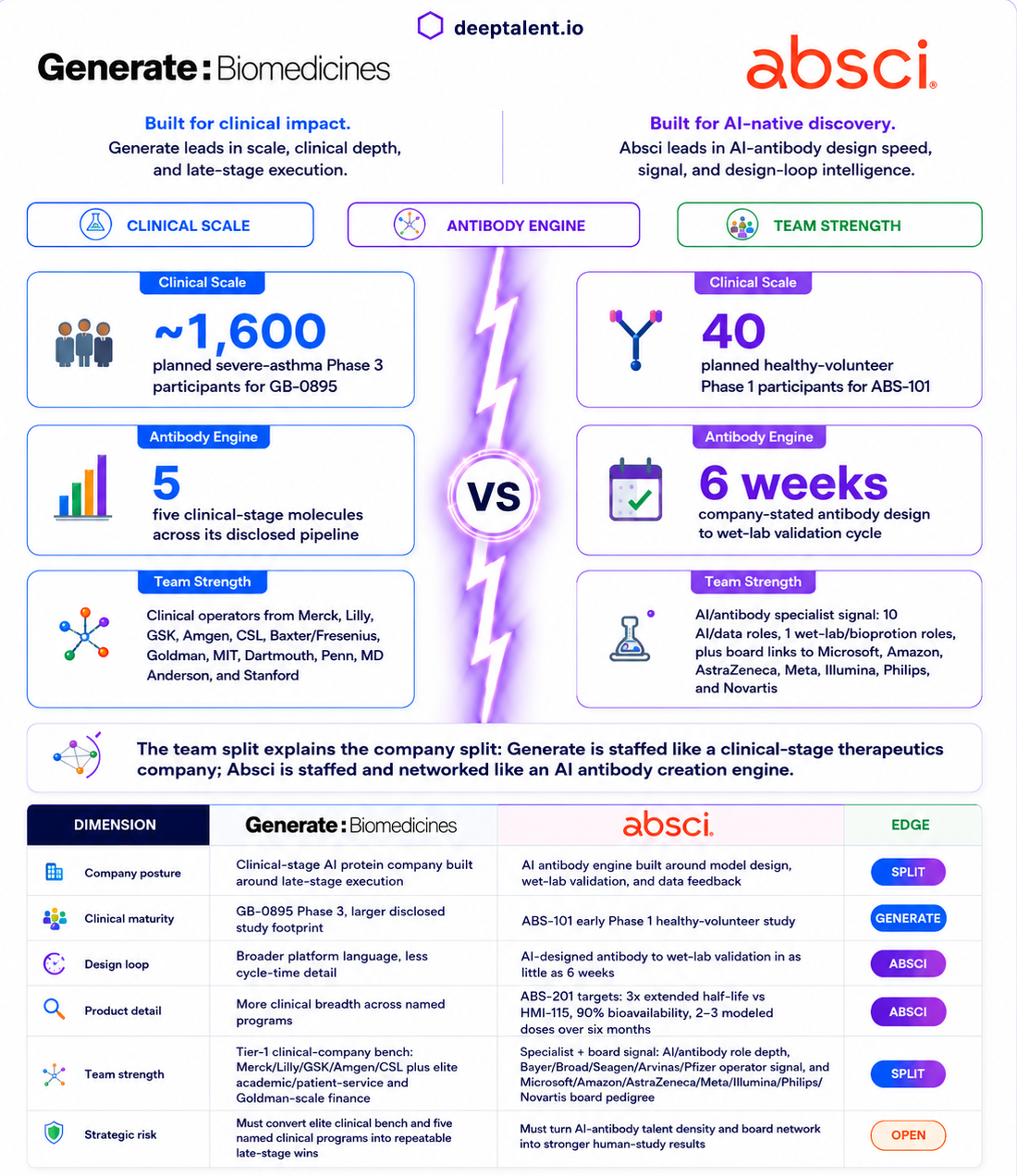
Generate Biomedicines reads like a company pushing AI-designed proteins toward clinical execution, partnership economics, and late-stage operating discipline. Absci reads like a company centered on AI antibody creation, wet-lab validation, and platform-through-product iteration.
For candidates, the difference changes the daily work. For hiring teams, the difference changes which backgrounds matter: clinical execution, translational biology, biologics discovery, antibody optimization, machine learning, business development, regulatory strategy, or platform operations.
Generate is closer to clinical execution
Generate Biomedicines presents itself around programmable protein therapeutics, a clinical pipeline, and partnerships that require execution beyond early discovery. The company has emphasized clinical-stage molecules, large pharma collaborations, and a platform intended to design proteins across multiple therapeutic categories.
That puts hiring pressure on more than machine learning and protein design. A company moving AI-designed proteins toward patients needs clinical operations, regulatory strategy, CMC, quality, translational medicine, program leadership, alliance management, and finance.
Absci is centered on AI antibody creation
Absci’s public materials emphasize an integrated drug creation platform that combines AI design, wet-lab validation, antibody discovery, and biologics engineering. Its public updates around ABS-201 and related programs show a company trying to compress the path from computational design into experimentally validated therapeutic candidates.
That creates a different hiring center of gravity. Absci roles are more likely to reward people who understand antibody design, protein engineering, high-throughput biology, ML model iteration, translational assays, and the tight feedback loop between modeling and lab results.
The role question matters
A candidate comparing the two companies should ask where the role sits. A role near Generate’s clinical programs may be judged by trial execution, program quality, partner readiness, and late-stage discipline. A role near Absci’s platform may be judged by stronger molecule design, better experimental validation, and faster iteration into product candidates.
The company name alone gives an incomplete view. The more useful question is whether the job supports the core science, the clinical pipeline, the platform, or the operating system around the business.
Candidate questions
Candidates should ask which part of the company the role serves, how close the work is to the molecule, and which result will define success. Better models, stronger antibody candidates, better trial execution, faster wet-lab validation, and cleaner partnership execution all require different skills.
A protein scientist, ML engineer, translational biologist, clinical operations leader, and business development hire can all belong in AI protein therapeutics. The match depends on where the company is placing pressure right now.
Hiring team questions
Hiring teams should define whether the role is solving a platform problem, a molecule problem, a clinical problem, or an operating problem. That decision should shape the shortlist before titles and prestige enter the conversation.
DeepTalent.io helps hiring teams compare company context, role scope, technical depth, and candidate work history so AI-protein companies can find people who fit the specific work in front of them.
The operating split is broader platform versus antibody design loop
The project research compared Generate and Absci across platform breadth, program maturity, wet-lab validation, partnership confidence, and the way each company describes its build model. Generate’s public materials point toward a broader generative-biology platform across protein modalities. Absci’s public materials put more weight on antibody design, scalable wet-lab cycles, and program-specific therapeutic readouts.
That distinction should shape both candidate positioning and hiring. A Generate role may require comfort with clinical-stage execution, platform breadth, CMC, regulatory work, and alliance pressure. An Absci role may reward antibody engineering, translational assays, model-to-lab feedback, developability, and biologics discovery. Both companies need AI and biology together, but the work sits in different operating systems.