Biotech Pay: Which U.S. Hub Fits Your Role?
DeepTalent.io maps biotech compensation by role, specialty, and U.S. hub so scientists and engineers can see which locations offer the strongest pay guide for their work.
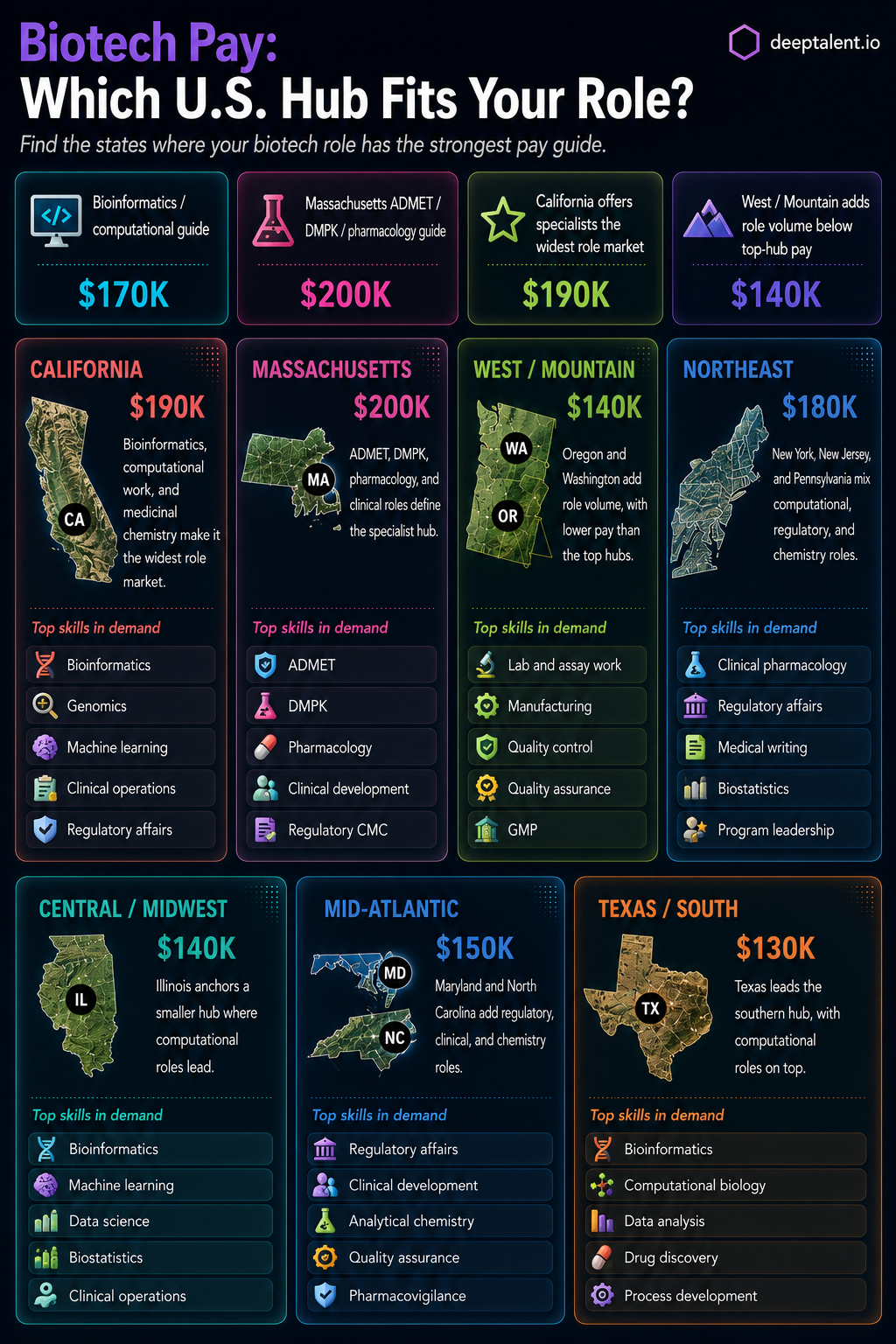
Biotech pay changes with the match between location, specialty, and the work companies are hiring for. The DeepTalent.io hub map points to California for bioinformatics, computational work, and medicinal chemistry; Massachusetts for ADMET, DMPK, pharmacology, and clinical roles; and the Northeast and Mid-Atlantic for different mixes of computational, regulatory, clinical, and chemistry work.
The practical question for candidates is where their exact role has the strongest pay guide. Scientists and engineers can use this map to decide which opportunities deserve a serious move, which regions fit their specialty, and where their background lines up with stronger compensation signals.
Role fit should lead the location search
A biotech hub can look strong at the headline level while still producing very different outcomes by specialty. Bioinformatics, computational biology, medicinal chemistry, ADMET, DMPK, clinical pharmacology, regulatory affairs, quality, manufacturing, data science, and program leadership all cluster differently across the United States.
That is why the hub decision should start with the actual work. A candidate deciding between California, Massachusetts, the Northeast, the Mid-Atlantic, Texas, the South, the West, or the Mountain states needs to know which companies are hiring for their specialty and which roles are paying for that specialty.
California carries the widest computational and discovery market
The map puts California at a $190K guide, with bioinformatics, computational work, and medicinal chemistry defining the widest role market. That combination matters for candidates whose backgrounds sit across genomics, machine learning, data science, drug discovery, clinical operations, and regulatory affairs.
California can be especially useful for candidates who want a larger surface area of companies and teams. The tradeoff is competition, cost of living, and the need to separate strong role fit from broad hub visibility.
Massachusetts is strongest for specialist translational depth
The map puts Massachusetts at a $200K guide, with ADMET, DMPK, pharmacology, clinical development, and regulatory CMC shaping the specialist hub. That is a different career signal from a general biotech market because these roles reward depth in how programs move from discovery into development.
For candidates with pharmacology, DMPK, clinical, or CMC experience, Massachusetts can offer a clearer match between senior technical background and compensation. Hiring teams in that hub often need candidates who can connect biology, chemistry, development risk, and program execution.
Regional hubs create different opportunity paths
The Northeast shows an $180K guide in the map, with New York, New Jersey, and Pennsylvania mixing computational, regulatory, and chemistry roles. The Mid-Atlantic shows a $150K guide across Maryland and North Carolina, with regulatory, clinical, analytical chemistry, quality assurance, and pharmacovigilance demand.
The West and Mountain states show a $140K guide, with Oregon and Washington adding role volume across lab and assay work, manufacturing, quality control, quality assurance, and GMP. The Central and Midwest region shows a $140K guide anchored by Illinois, where computational roles can lead. Texas and the South show a $130K guide, with bioinformatics, computational biology, data analysis, drug discovery, and process development in the mix.
How candidates should use the map
Candidates should treat the map as a role-targeting tool. Start with the work you actually want to do, then compare which hubs show stronger compensation guideposts, deeper company density, and more roles tied to your specialty. The useful move is the one where the role, the company base, and the pay guide line up.
For scientists and engineers, this can change the job search quickly. A role that looks average in one region may become more valuable in another, while a well-known hub may still be weak for a specific specialty. The goal is to focus time on roles that fit your background and location goals.
How DeepTalent.io uses hub context
DeepTalent.io maps companies and available roles across the United States so candidates can compare opportunities by role, specialty, company context, and location. The system is built to help scientists and engineers see which jobs are worth attention and which moves make sense for the work they actually do.
For hiring teams, the same geography matters in reverse. A team that needs a computational biologist, DMPK scientist, regulatory leader, clinical operator, or process-development engineer has to know where that talent pool is strongest and how compensation expectations change by market.