10x, Parse, and BD Rhapsody Point to Different Single-Cell Jobs
Single-cell genomics roles can look similar in a job title while asking for very different workflow experience across 10x Genomics, Parse Biosciences, and BD Rhapsody.
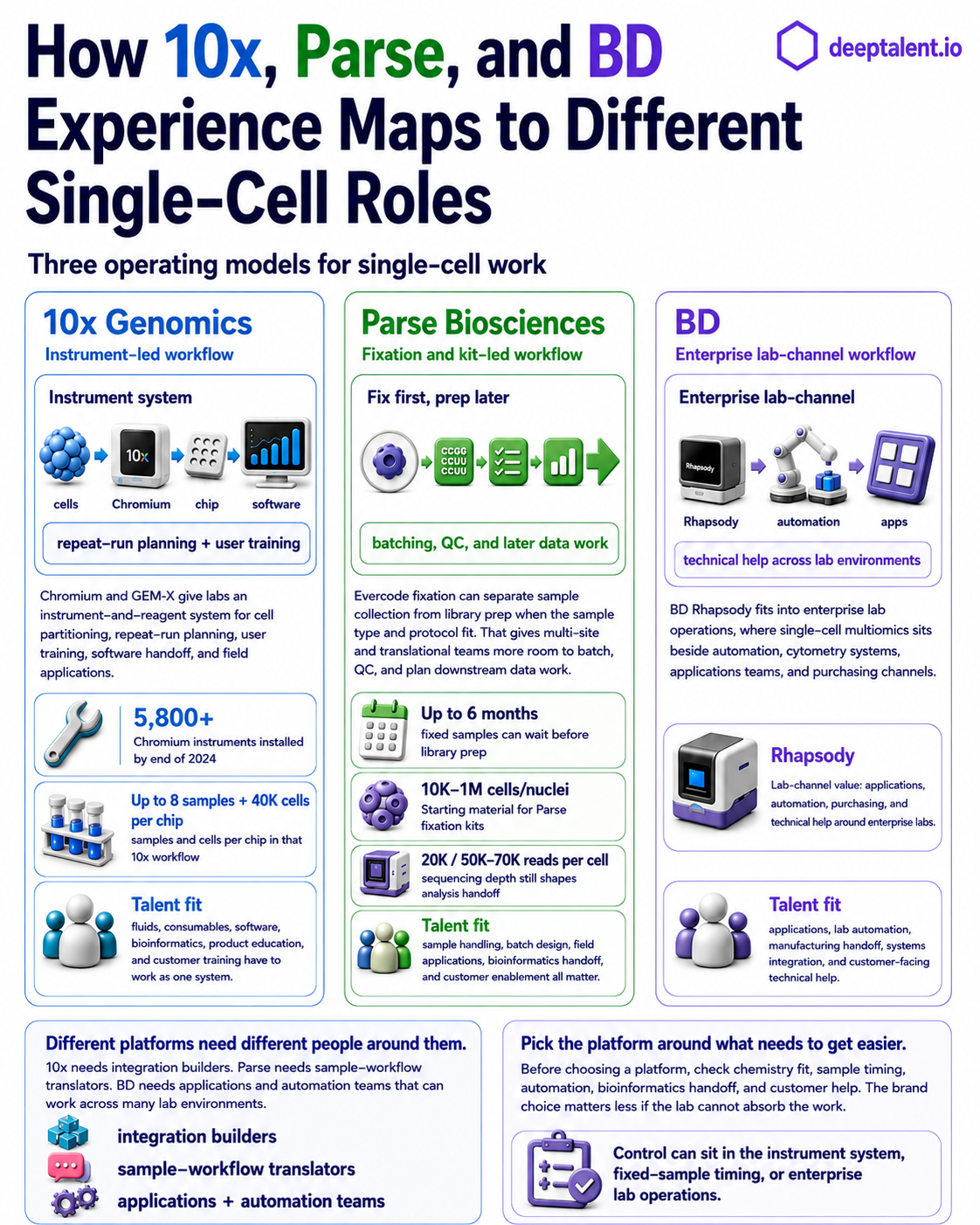
A single-cell genomics title can hide very different work. 10x often points toward Chromium runs, chip setup, reagent workflows, user training, software handoff, and applications support. Parse often points toward fixation, batching, timing, QC, protocol fit, and downstream handoff. BD Rhapsody often points toward automation, cytometry-adjacent work, lab operations, and customer-facing technical support.
Candidates should describe the workflow they actually handled. Hiring teams should write for the workflow they need.
10x experience points toward instrument workflow fluency
10x Genomics Chromium work often rewards people who can handle chip setup, reagent timing, sample prep, library construction, troubleshooting, and user handoff. In many roles, the job is less about saying single-cell and more about keeping a complex workflow running across samples, instruments, software, and downstream teams.
That experience can matter for field applications, translational research, core lab operations, genomics platform roles, and teams that need someone who can support scientists using the system under pressure.
Parse experience points toward batching and sample timing
Parse Biosciences built much of its positioning around fixation, sample batching, and workflow flexibility. In hiring terms, that can reward candidates who understand sample timing, fixation decisions, protocol design, QC, and how to preserve optionality across many samples before sequencing.
For candidates, Parse experience should be described through the actual work performed: sample handling, timing choices, throughput planning, protocol adaptation, quality checks, and coordination with downstream bioinformatics.
BD Rhapsody experience points toward automation and lab operations
BD Rhapsody sits near automation, single-cell multiomics, cytometry-adjacent work, and technical operations. Roles tied to this environment may value people who can support instrument operation, lab process control, customer support, applications work, and multiomic workflow decisions.
That is a different job shape from a pure computational genomics role. It asks for hands-on comfort with systems, users, samples, and the operational details that keep single-cell work reliable.
Candidate positioning
Candidates should avoid treating single-cell as one undifferentiated keyword. A stronger description names where their work sat: sample handling, instrument operation, workflow design, automation, computational handoff, applications support, user training, or customer-facing technical work.
That helps employers understand whether a candidate can solve the workflow problem they actually have.
Hiring team positioning
Hiring teams should write role descriptions around the work instead of using a broad single-cell label. A role built around Chromium support, Parse-style batching, or BD Rhapsody automation will attract different candidates.
DeepTalent.io helps match candidates to the exact workflow experience behind the title so teams see the difference before interview time is wasted.
Workflow language should replace broad single-cell language
The DeepTalent.io research found that the strongest comparison is a workflow map. 10x belongs to an instrument-and-consumables workflow. Parse belongs to a fixation and kit workflow. BD belongs to an enterprise lab-channel workflow with multiomic and cytometry-adjacent strengths.
That matters because a single job title can hide different daily work. A 10x-heavy role may ask for chip setup, GEM-X or Flex workflow fluency, Cell Ranger handoff, and user support. A Parse-heavy role may ask for sample timing, fixation, batching, split-and-tag barcoding, and protocol planning. A BD Rhapsody role may ask for cartridge workflow, AbSeq, customer enablement, and lab operations. The more specific the workflow, the better the match.